// guide · exploring
// the home system
This page shows you how to chart the other worlds around your star with a deep-space probe, mine them with world outposts, and later reach the systems beyond your own.
The home system opens at Level 8. World outposts follow at Level 9, the lander's seeding flights at Level 10 and the systems beyond home at Level 13.
// build a deep-space probe
where to find it · [ explore ] → // system
- Under
[ colony ], repair the navigation core among the wreck's parts. It plots courses beyond the moons. - Under
[ research ], research Astrometry. - Press
[ build ]on the deep-space probe's card in// system.
The Factory builds the deep-space probe, on the same line as the moon probe and the rover, one thing at a time. The colony holds one, a second from Level 13 and a third from Level 24, when the card comes back to build it.
// chart a world
// system lists the home system's four to six other worlds, nearest first, by designation and distance. Until a world is charted, its traits and its find are unknown, and its line gives the length of the trip.
Press [ chart ] on the world you want. A charting costs nothing and can't be called back. The probe flies out, charts the world and flies home, which takes hours rather than minutes: the further the world, the longer the trip. When it is home, the world's line names its find and its traits.
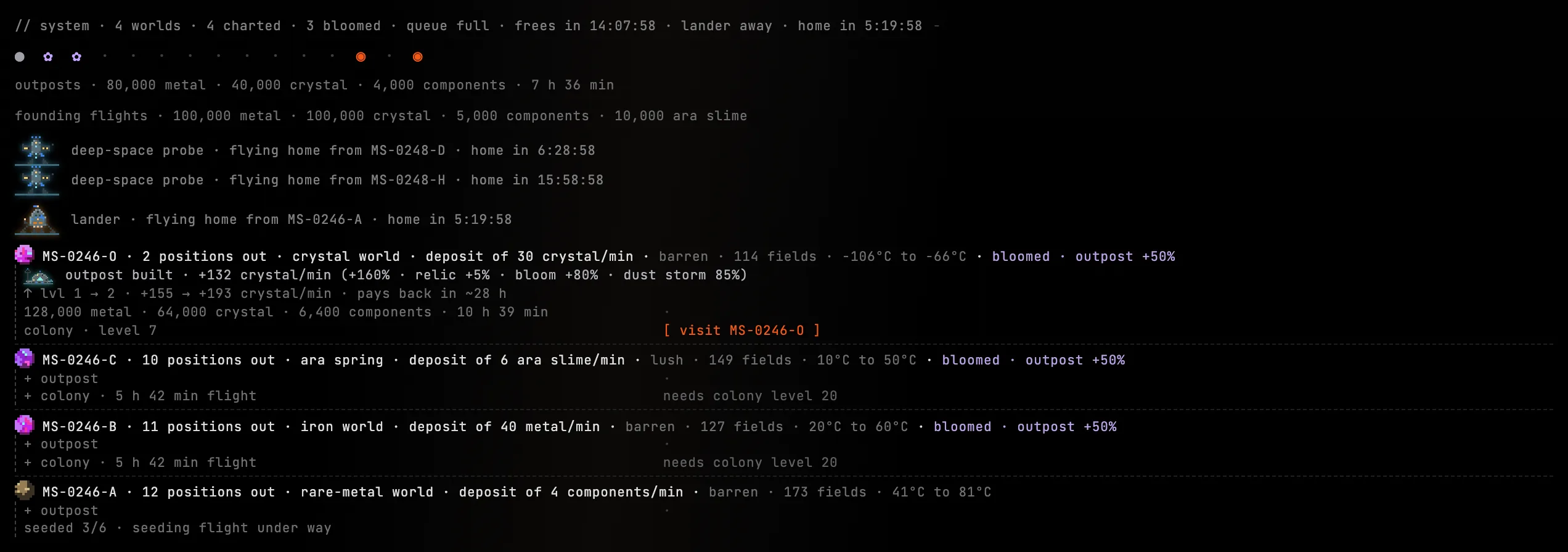
From Level 16, the deep-space probes can chart the nearest uncharted world by themselves, one after another: see Standing orders.
A world's find is either a deposit, which a world outpost can mine, or a curiosity, which pays out once with a relic and a large cargo. The nearest world always holds a deposit.
// build a world outpost
Research Interplanetary Logistics at Level 9. A charted world with a deposit then carries an outpost line, with its cost and build time. Press [ build outpost ], or [ queue ]. One outpost fits each world. It goes through the build queue, takes no field and draws no Energy.
Once built, its line shows what it yields each minute, with your research and relic bonuses. From Level 10 it levels like a building, with its next level and [ upgrade ] under it.
// seed a world
From Level 10, once the drive is repaired, the lander can carry Ara slime to a charted world. Each charted world ends in a seeding line with [ seed ], and six seedings bloom a world, so that its outpost produces half as much again. Ara slime and blooming covers the flights.
From Level 25, a second lander built on the slipway can fly beside the first, so two seeding flights can be out at once. See The slipway.
// beyond the home system
From Level 13 a second deep-space probe joins the first, and charting reaches the systems beyond yours. Each one has a section of its own under // system, headed by your system's designation and how many steps out it lies, such as // system MS-0421 +1.
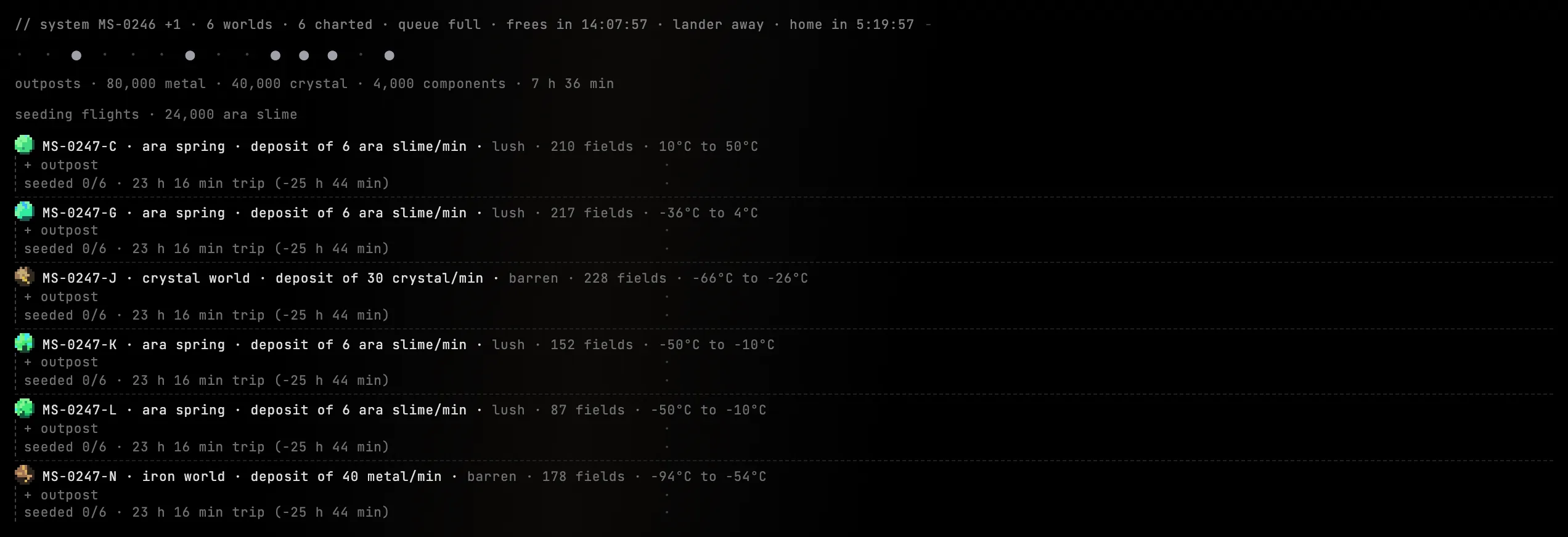
You can see the next two systems out, and always one beyond the furthest you have charted, so there is always somewhere further to go. Trips there take a day or more each way. Charted worlds beyond home carry outposts and take seeding flights as your own system's worlds do.
// green a system
Once every world round a star has bloomed, the system greens, for good. In your home system that means every one of its worlds charted and then bloomed by six of the lander's seedings, as well as your own planet, which has bloomed by Level 10. A system beyond home greens by the same rule, and a world one of your colonies stands on counts as bloomed, since the lander bloomed it before the settlers landed.
The system greens the minute the lander comes home from the last world's sixth seeding. Its heading under // system then ends in greened, and the home colony's log says so beside that world's bloom.
- Each greened system adds 5% to the Ara slime output of every colony you hold, for good. A slime yield names it beside the other bonuses, as
greened +5%. - A colony whose own system has greened sees it in its sky, as a faint purple wash behind the planet and the system's worlds as soft purple points among the stars.
- The planet's close-up counts the systems greened, and the journal under
[ log ]lists each one with when it greened.